Home
Notes
Notes
Notes
Notes
Notes
Notes
Notes
Notes Index
Short Posts
P/E10
Stock Returns
Year 30 SWR
Year 15 SWR
Scenario Surfer
Strategy Tester
TIPS Table
S&P500 Dividends
S&P500 Returns
Graphs
More Graphs
Guidelines
Dividend Guidelines
Foundations
May Highlights
Lucky-7 Archives
Current Research N
Current Research O
Current Research P
Current Research Q
Current Research R
Current Re Index
Archives
Dividend Archives
 Books
Contact Us
Letters Index
Letters
Letters
Letters
Letters
Letters
Letters
Letters

Take 6%

This is what happens at Year 20 if you withdraw 6% of your portfolio’s CURRENT balance each year.

Conditions

I determined the (real) Year 20 balance after starting with $100000. I examined a portfolio with 50% stocks and 50% TIPS and another portfolio with 80% stocks and 20% TIPS. The TIPS (real) interest rate was 2%. Each year, I withdrew 6% of the portfolio’s CURRENT balance. I plotted the Year 20 withdrawal amounts (in real dollars) using four year smoothing.

Graph

This picture shows the Year 20 withdrawal amounts (smoothed over four years) versus the percentage earnings yield of the S&P500 (100E10/P) starting from 1923-1980.
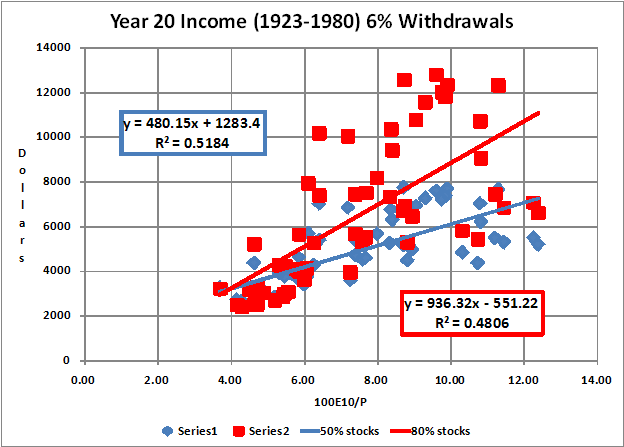


Observe that the amount withdrawn can fall to very low levels when the starting valuations are high (P/E10=20 or above, 100E10/P=5% or lower). Notice that the amount withdrawn at today’s valuations (P/E10=16 and 100E10/P=6%) generally stays above 4% of the original balance (plus inflation). It often does much better.

Observations

My original investigations showed that withdrawing a constant percentage of the portfolio’s CURRENT balance could result in very low income levels at Year 20. [Portfolios did better at other times.] This is only true when starting at times of high valuations. At other times, the strategy can make sense.

Those who withdraw 6% of their portfolio’s CURRENT balance today can expect to do well. The downside risk is roughly that their income will fall to 4% of the original balance (plus inflation).

Have fun.

John Walter Russell
July 1, 2009